Troubleshooting · 17 Feb 2025
Another possible bug in the OBTD calculations: Why are excitations stronger than decays?
Investigating why apparent excitation contributions exceed decay contributions in OBTD grids.
Making sure that initial and final states are ordered correctly
Feast your eyes on the below figure:
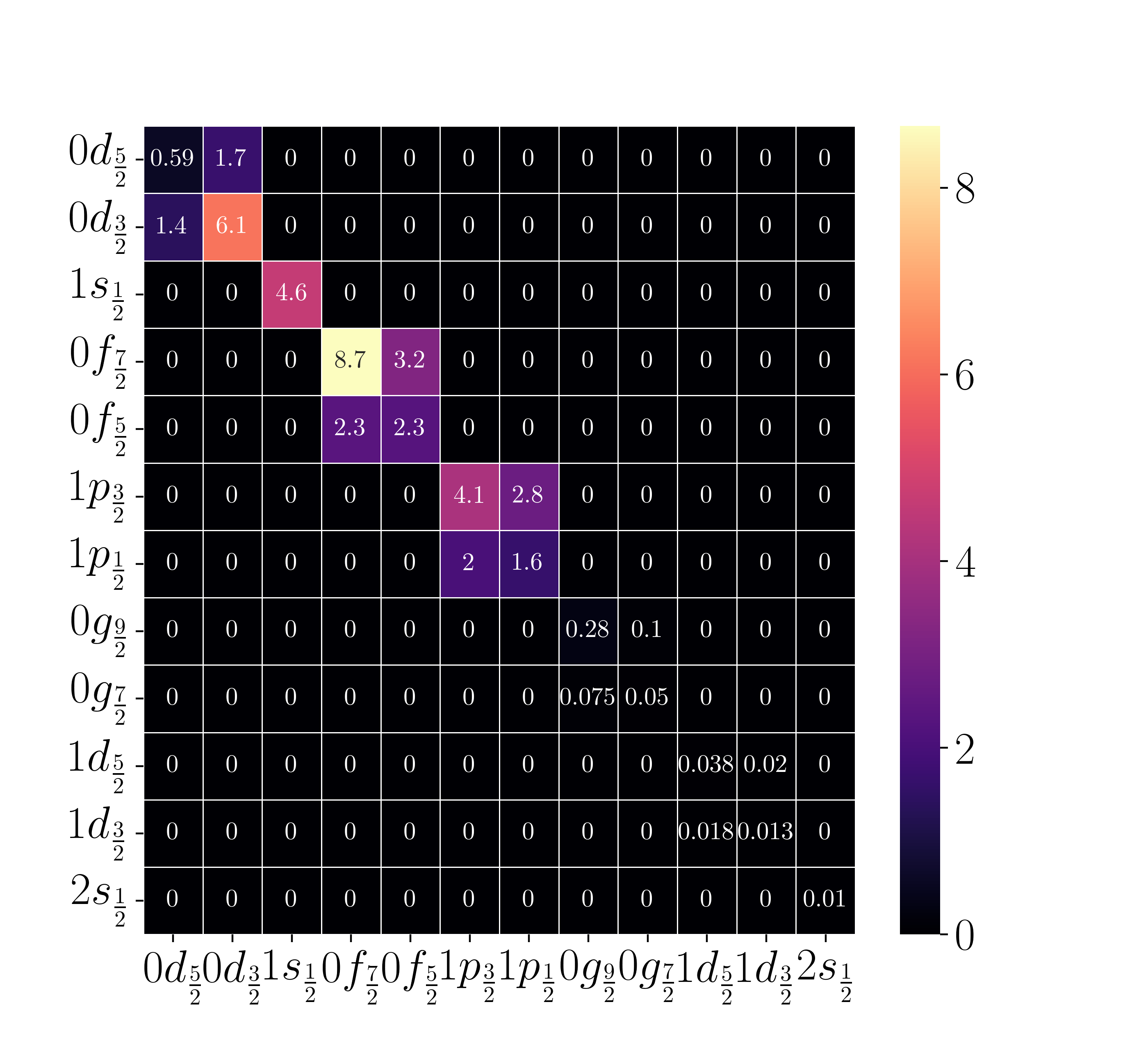
It might seem fine and dandy, but consider this: If you look at for example with a value of 3.2 %, note that it is larger than the reverse which is at 2.3 %. Since is at lower energy than and consequently that should be more energetically favourable than the opposite, then how come the opposite has a larger percentage of the OBTDs? It might simply be that I incorrectly have swapped some indices, let’s take a closer look at that!
Recall that kshell-utilities checks whether or not the final state has lower energy than the initial state and swaps them if that is not the case. However, the OBTDs are stored in separate files, also organised after angular momentum and parity, for example ‘…j0n…j2n…’, and I have not implemented such a check and swap for the OBTD files! The reverse file ‘…j2n…j0n…’ does not exist as KSHELL stores both 0n to 2n and 2n to 0n in the ‘…j0n…j2n…’ file, and since all the entries in that file is organised with 0n to the left and 2n to the right, I need a way to say which is which…
Here is an excerpt from a KSHELL log file containing transitions between and states (the values in the below list are multiplied by 2):
 M1 transition  mu_N^2  gl,gs=  1.1000 -0.1000  5.0270 -3.4430 parity -1 -1
  2Jf   idx  Ef        2Ji   idx  Ei          Ex        Mred.           B(EM )->        B(EM)<-         Mom.
   0     1   -391.893   2     1   -392.049    -0.157     -0.24234772      0.05873242      0.01957747      0.00000000
   0     1   -391.893   2     2   -391.739     0.154      0.22704159      0.05154788      0.01718263      0.00000000
   0     1   -391.893   2     3   -391.501     0.392      0.30656887      0.09398447      0.03132816      0.00000000
Consider now the relation between the reduced matrix element and the reduced transition probability:
If we take the reduced matrix element (Mred.) for the first transition, we see that
so if we take as the decay probability then it seems that the state is the initial state of the decay, while the state is the initial state of the excitation. This seems contrary to the header of the table…
Now consider that for this transition, the energy of the final state is actually higher than the energy of the initial state, aka. is negative. A decay where is no decay at all, but rather an excitation, and I would dare say that in the table consequently is the excitation probability. To make sense of it all, I will for transitions of negative flip the roles of initial and final, and decay and excite.
While conceptually simple, it proved to be a bit of a riddle to solve this programmatically because I want it to fit with my existing dictionary structure. I think it is solved now, and as any programmer should do, I implemented tests which I do believe covers all of the possible cases. The tests are called every time is called which is practically speaking every time is called.
I have now double and triple checked that the OBTDs are organised so that and just to be sure I have put checks into the code that generates the OBTD grids that is indeed true, and something has happened to the values, however not what I was aiming for in this text… (protons left, neutrons right)
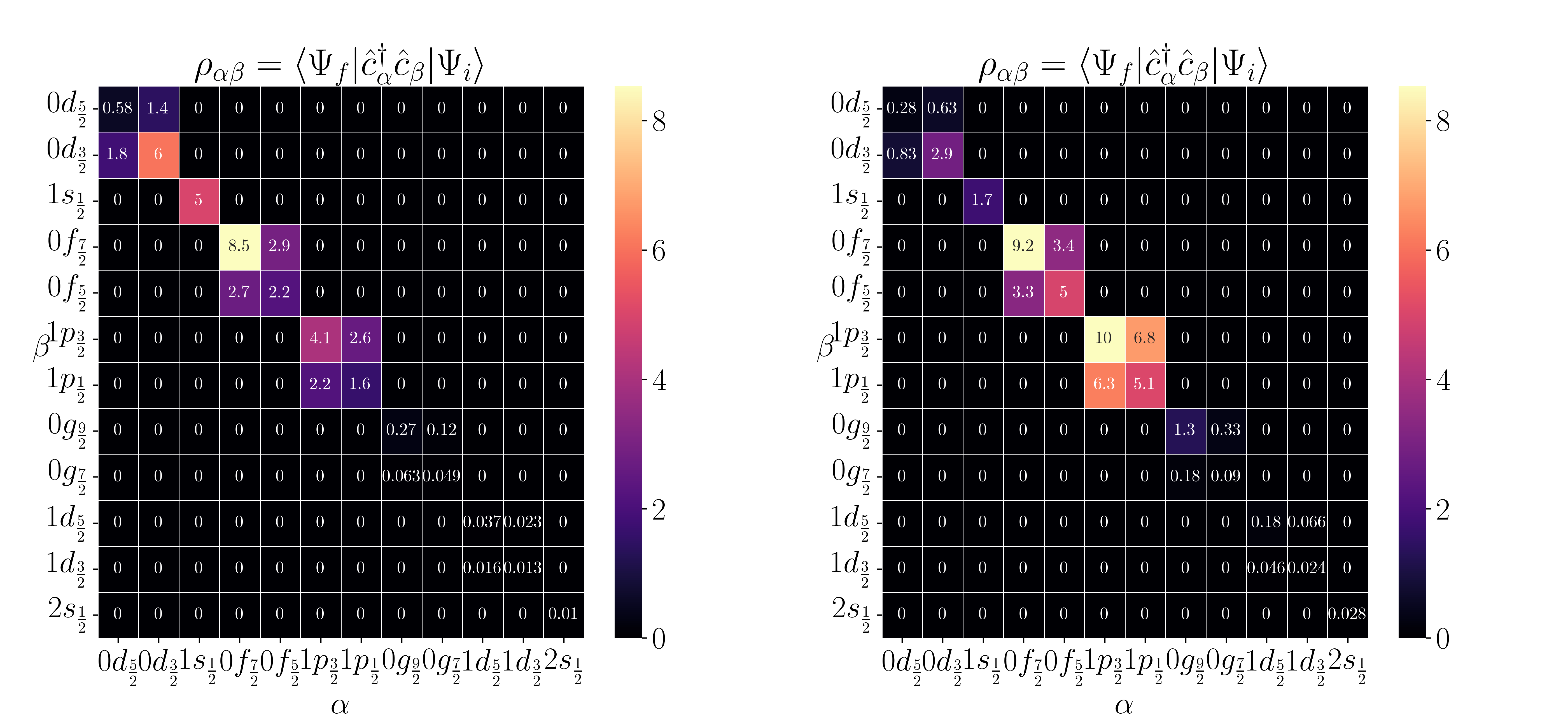
Wth is going on
So after all that making sure that the levels are correct, I still get that the excitation “strength” is larger than the decay. So let us now elaborate on why I’m calling it “strength” and not strength. In the plots we’re just looking at the OBTDs which are not the complete expression for the (reduced) transition strength. So maybe we are led astray by that fact? Let’s see what happens if we plot not only the OBTDs but the OBTDs multiplied by the single-particle transition matrix elements (see the definitions here). We’re still not looking at the actual reduced strength as we would need to sum up over all the orbitals / single-particle contributions to get the actual strength and then we would no longer be able to make the grids.
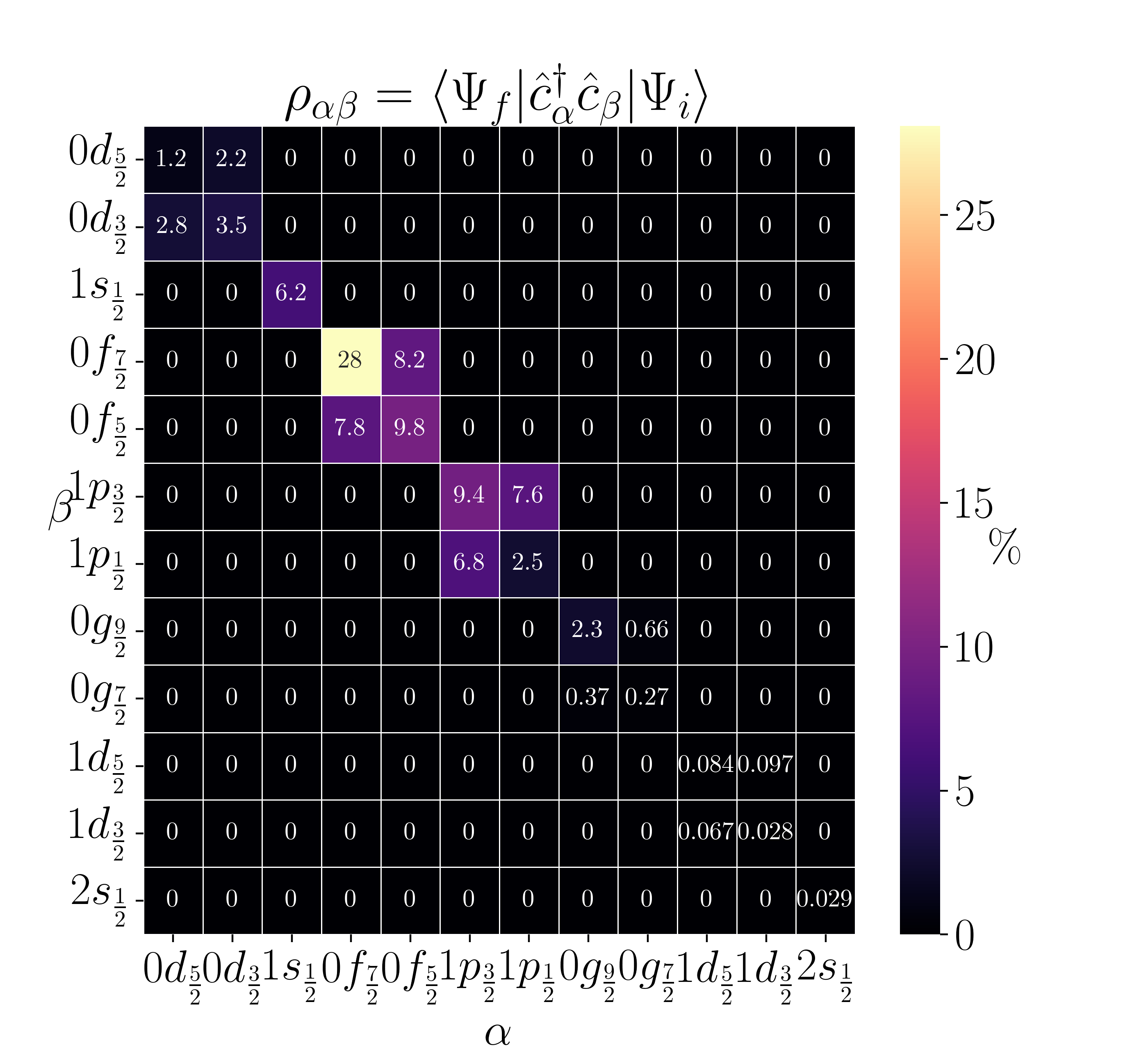
Hmm, it seems that the excitation “strength” is still not afraid of being larger than the decay “strength”… What if we sum up without taking the abs of each term?
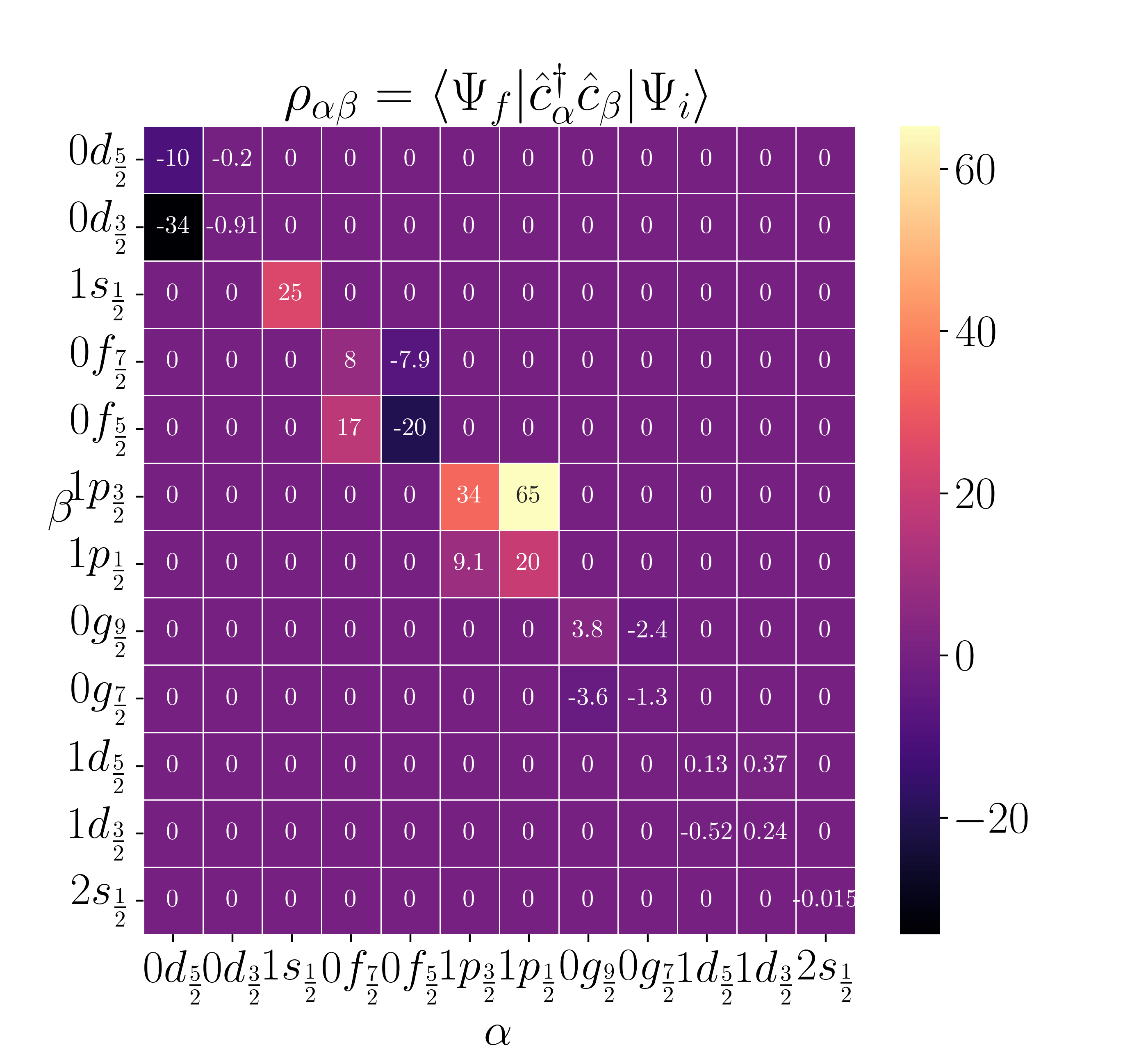
Nope, does not seem to solve anything. Let’s think about the original assumption, namely that the decay strength should be larger than the excitation strength. That is an alright assumption, but remember that we are not actually looking at true strengths here, even if we multiply the OBTDs by the L, S terms. So maybe the assumption is bad for this situation?
Discussion
Comments
Comments are public. Anonymous sign-in stores an identity in your browser; basic network metadata is retained for abuse prevention.